
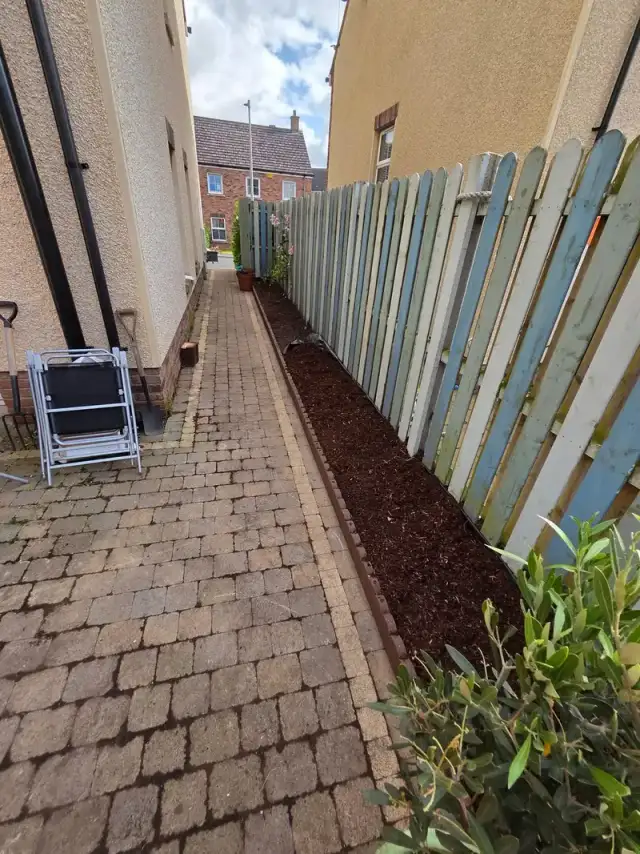
Taking on a new build garden is one of the most satisfying landscaping projects you can do, but it is also one where the mistakes are most costly. The ground conditions on new estates are almost always poor, the builder has typically done the minimum, and it is tempting to just lay some turf and be done with it. That approach usually results in a waterlogged, uneven lawn that needs redoing within two or three years.
This guide covers what to expect on a new build site in County Louth, what to do first, and how to build a garden that actually works rather than one that looks okay for a year and then starts causing problems.
What You Are Usually Starting With
Most new build gardens in Ireland are handed over with:
- Subsoil only, with little or no topsoil. The topsoil is often stripped during construction and sold or disposed of.
- Heavily compacted ground from machinery and foot traffic during the build.
- Poor or no drainage. The compaction means water sits on the surface rather than soaking in.
- A slope or uneven surface that drains towards the house rather than away from it.
- Rubble, concrete splashes, and construction debris mixed into the ground.
This is the baseline. It is not a failure on your part or the builder’s alone. It is just what new build gardens look like before work starts.
Step One: Drainage and Levels
Before you do anything else, sort the drainage and the levels. This is the step most homeowners skip because it is invisible once it is done, and the money feels like it is going into the ground without any visible result. But it is the most important investment you will make in the garden.
Signs of poor drainage on a new build plot:
- Standing water after rain that takes more than 24 hours to clear
- Soft, spongy ground in patches
- Water ponding near the house or the back wall
Solutions depend on severity. For moderately poor drainage, a layer of crushed stone under the lawn and around the perimeter is often enough. For persistent problems, French drains or a soakaway system may be needed. In County Louth, the heavier clay soils in parts of Dundalk and inland areas drain particularly poorly. This is not a job to leave.
Levels also matter. The garden should fall away from the house, not towards it. If the builder has left the ground level or sloping inward, this needs to be corrected before any surface work begins.
The Order of Works for a New Build Garden
If you are planning a full garden project, the sequence matters:
- Clearance and debris removal (remove all rubble, construction waste, and any material that does not belong)
- Drainage installation if required
- Ground levelling and shaping (cut and fill to create the finished levels)
- Sub-base work for any paved areas
- Hard landscaping: patio, paths, boundary fencing, retaining walls
- Topsoil bring-in: typically 100 to 150mm of good quality topsoil across lawn areas
- Soft landscaping: lawn laying, planting beds, hedging
Do not bring in topsoil until drainage and hard landscaping are done. Otherwise you are doing remedial work in good soil that is difficult to clear properly.
How Much Topsoil Do You Need?
For a lawn area to establish well in County Louth, you need a minimum of 100mm of good topsoil over a prepared, loosened sub-base. For most new build gardens in the county, the existing ground is compacted enough that you also need to break up and loosen the top 150-200mm of subsoil before spreading topsoil, so that roots can penetrate beyond the topsoil layer.
For a 60m² back garden lawn area, you are looking at 6 to 8 cubic metres of topsoil as a rough minimum. Buying cheap topsoil on a new build garden is one of the most common false economies we see. Poor quality topsoil is full of weed seeds, often has poor structure, and can create a problematic layer if it sits on compacted subsoil.
Patio on a New Build: What to Consider
Most new build homeowners want a patio as part of the initial garden project. A few considerations specific to new build sites:
The house is still settling. New builds move slightly in the first one to three years as the ground consolidates and the structure settles. This does not normally affect a well-built patio, but it does mean any steps or levels should allow for small movement at the junction with the house.
DPC clearance. Your patio must be laid at least 150mm below the damp-proof course (DPC) in the external wall of your house. Building too high risks moisture bridging into the structure. Check the position of your DPC before setting the finished patio level.
Water management at the house. How does water get from your patio and garden away from the house? On a new build, the drainage connections are often minimal. Make sure your patio falls away from the house and that there is a clear route for surface water.
Garden Layout Ideas for New Build Properties
New build gardens in County Louth tend to be regular in shape and moderate in size, which makes them easier to plan than older, awkwardly proportioned plots. A layout that works well for most:
One-third patio, two-thirds lawn. A patio of around 20 to 30m² gives enough space for outdoor furniture, a BBQ area, and a small play zone. The remaining garden is lawn, which is low maintenance and gives children space.
Boundaries first. Get the fencing sorted early. It defines the space, gives privacy, and means the garden feels usable much sooner.
Planting beds along one boundary. A bed along the rear or side fence breaks up the lawn, softens the space, and gives something to develop over time without committing to a complex layout on day one.
Leave space for storage. A shed or bike store is often an afterthought on new builds. If you want one, plan its position before the garden is fully laid out so it can be positioned sensibly and accessed without trampling across a lawn.
Common Mistakes to Avoid
Laying turf on compacted subsoil. It will grow for a year and then thin out and go patchy as the roots hit impenetrable ground.
Not sorting drainage first. Any surface water problem gets worse once the garden is established and the ground is covered.
Doing it all at once on a very tight budget. If budget is limited, prioritise drainage, boundary fencing, and a basic patio in year one. Do the lawn and planting in year two with better quality topsoil and turf.
Going for the cheapest quote. On a new build garden, the groundwork is most of the cost. A very cheap quote almost always means corners cut on the preparation that determines whether the finished garden lasts or fails.
For a free, no-obligation quote on new build garden landscaping in Dundalk or anywhere across County Louth, get in touch here.
For more on related topics: garden landscaping costs in Ireland, sloped garden ideas, retaining wall options, and our garden landscaping service page.