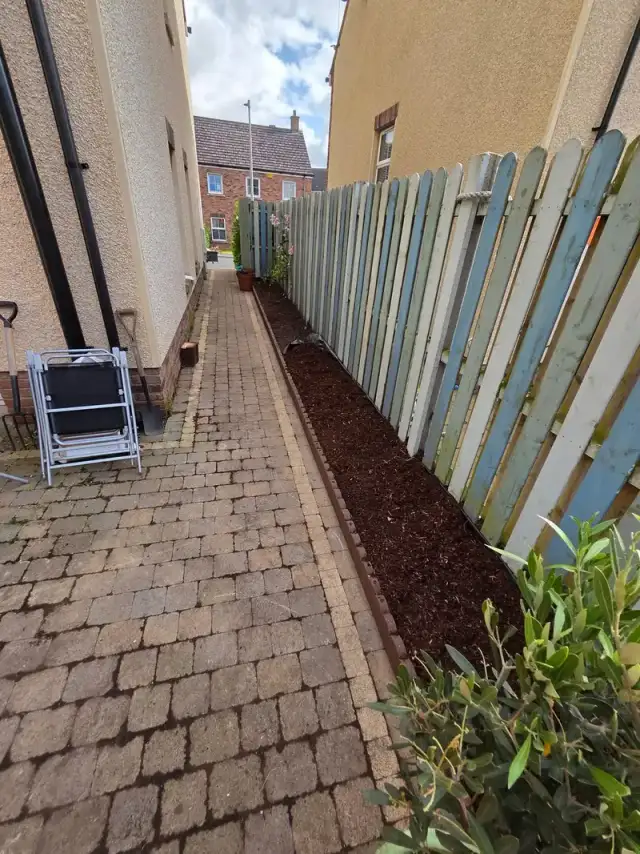
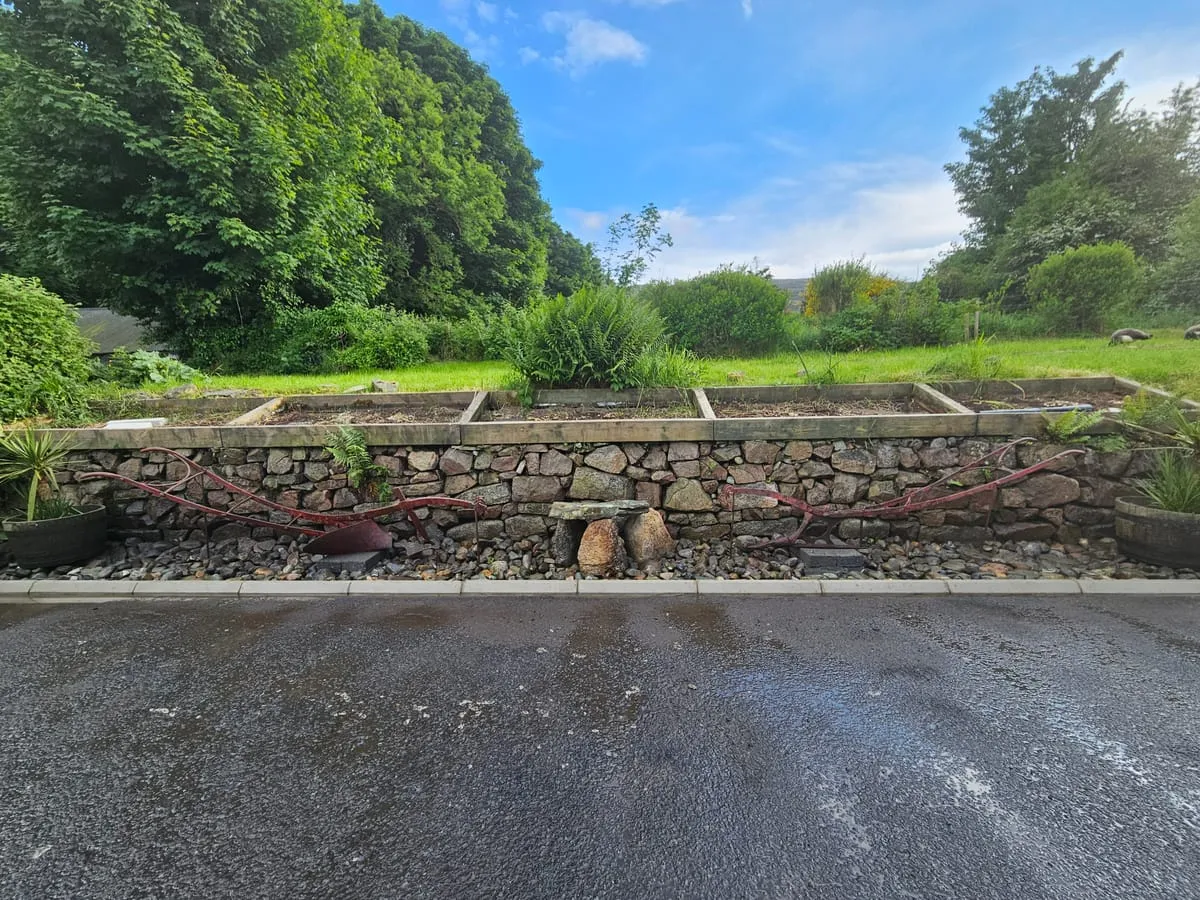
A retaining wall does two jobs at once. It holds back soil on a sloped site, turning a difficult slope into usable terraced levels. And it is a prominent visual feature in the garden, so it needs to look good as well as function well.
The choice of material, the height, and the way the wall is built all affect both its appearance and how long it lasts. Here is a practical guide to the main options for Irish gardens, along with the construction considerations that matter most.
Railway Sleeper Retaining Walls
Sleeper walls are the most popular choice for domestic garden terracing in County Louth, and they have earned that position. They look good in a wide range of garden styles, from informal cottage gardens to more contemporary planting schemes. They are cost-effective. And they can be installed relatively quickly.
New hardwood sleepers, typically 2.4 metres long by 200mm by 100mm, are stacked horizontally and fixed to vertical posts driven into the ground behind the wall. The posts take the lateral load of the soil; the sleepers provide the facing.
For walls up to about 600mm, untreated or lightly treated sleepers work well. For taller walls, pressure-treated timber and proper vertical posts are essential. A sleeper retaining wall that starts to lean forward is a structural problem, not just an aesthetic one.
Sleepers are also the obvious choice for raised bed walls, low terrace edges around patio areas, and step risers. The material ties the whole garden together visually when used consistently across different elements.
Natural Stone Retaining Walls
A dry-stone or mortared natural stone retaining wall is the most characterful option and also the most labour-intensive to build. Dry-stone walls, where the stones are laid without mortar and rely on weight, mass, and careful placement for their stability, are a traditional feature of the Irish landscape. They allow natural drainage through the face of the wall and support a range of small plants and invertebrates between the stones.
Mortared stone walls are more structural and can be built taller. They require proper footings and drainage provision behind the wall to prevent water pressure building up. The choice of stone matters: locally sourced limestone or granite looks right in a County Louth garden in a way that imported sandstone or artificial stone does not.
Natural stone retaining walls are a significant investment in materials and labour, but they are essentially permanent. A well-built stone wall in an Irish garden will outlast the house.
Block Retaining Walls
Concrete block retaining walls, whether left as bare block or finished with render, cladding, or stone facing, are the most structurally flexible option. They can be engineered to retain greater heights than timber or dry-stone walls, and the finish can be specified separately from the structure.
Larger block retaining systems, such as interlocking concrete retaining blocks, are available for more significant height differences. These are commonly used on commercial sites but increasingly appear in domestic landscaping where a more substantial terrace is needed.
For a garden landscaping project involving retaining walls in County Louth, we often use block construction for walls above about 1 metre and then apply a stone or render facing to achieve the desired appearance. This gives the best combination of structural integrity and visual result.
Drainage Behind Retaining Walls
This is the point that causes the most problems when it is ignored. Water that builds up behind a retaining wall creates hydrostatic pressure. Over time, that pressure pushes the wall outward. A wall that was perfectly plumb when it was built will begin to lean forward as the seasons pass, and eventually it will fail.
The solution is simple and inexpensive to install at the time of construction: a layer of free-draining aggregate (clean stone, not soil) immediately behind the wall, with a perforated drainage pipe at the base that carries water away to a soakaway or existing drain. This eliminates pressure build-up entirely.
On County Louth’s clay-heavy soils, drainage behind retaining walls is not optional. It is essential.
Planting and Retaining Walls
Retaining walls create planting opportunities. The face of a dry-stone or sleeper wall can accommodate wall-hugging plants such as aubrieta, sedums, and mind-your-own-business. The top of a retaining wall, where there is a transition from the lower to the upper level, is a natural spot for a planting border or raised bed.
Planting softens the hard lines of a retaining structure and makes it feel like a deliberate part of the garden design rather than a purely utilitarian feature. Even a simple planting of trailing plants that spill over the top of the wall makes a significant visual difference.
Frequently Asked Questions
How tall can a garden retaining wall be without planning permission in Ireland?
There is no specific height limit for retaining walls set out in Irish planning legislation for domestic gardens. However, if the wall forms part of a fence or boundary structure, the standard permitted development height limits apply (1.2m at the front, 2m at the sides and rear). For a freestanding internal garden retaining wall, it is generally treated as exempt development regardless of height, but checking with Louth County Council is advisable for anything substantial.
How long do railway sleeper retaining walls last in Ireland?
Pressure-treated softwood sleepers used as retaining walls typically last 15 to 25 years depending on soil moisture levels and the quality of treatment. Hardwood sleepers last longer, often 25 years or more. The base and base plates fail before the sleepers themselves in most cases, so the posts are worth checking periodically.
Do retaining walls need footings?
Mortared stone and block retaining walls always need proper footings below the frost line, typically 300 to 450mm below ground in Irish conditions. Sleeper walls use vertical posts driven or concreted into the ground rather than a continuous footing, but the principle is the same: the wall must be anchored below the soil surface to remain stable.
For retaining walls, terracing, and garden landscaping across Dundalk, Ardee, Carlingford, Omeath, and all of County Louth, contact Seamus and Pete for a free, no-obligation quote.