
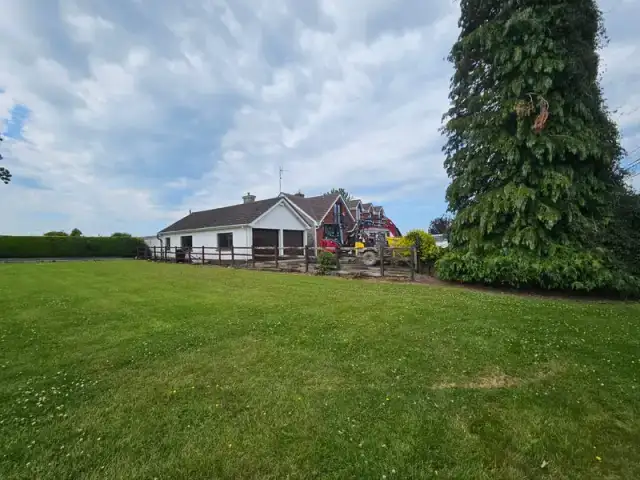
Ireland’s storm season runs roughly from September to March, and County Louth gets its share of serious storms coming off the Irish Sea and across from the Atlantic. Trees come down, branches fail, and gardens that looked fine in September can look very different by November.
If you have a tree damaged or downed in a storm, the first few decisions matter. This guide covers what to do immediately, what to assess, and when to call for professional help.
Immediately After a Storm: Safety First
Before anything else, assess the situation from a distance. Do not approach a fallen or partially failed tree until you are sure it is stable and there are no hazards.
Check for power lines. If a fallen tree or branch is in contact with any overhead cables, do not approach it at all. Call ESB Networks on 1800 372 999 (24-hour emergency line). Do not assume the lines are safe. Even if they appear intact, a tree resting on cables is exerting force that could cause them to fail. Keep everyone away until ESB has assessed and made the area safe.
Check for gas pipes. Roots pulling up during a fall can disturb underground services. If you suspect a gas pipe may have been affected, leave the area and call Gas Networks Ireland on 1800 20 50 50.
Assess whether the tree is stable. A tree that has partially fallen and is leaning against a fence, building, or another tree is under tension and unpredictable. Do not attempt to cut it yourself. The release of stored energy when a cut is made can be violent and dangerous.
Keep children and pets away from the area until it has been assessed.
Assessing the Damage
Once you are confident there are no immediate power or gas hazards, assess what has happened:
Complete fall: The tree has come down entirely, root plate lifted. The immediate danger is usually over but branches may be under tension.
Major branch failure: A large limb has broken and fallen, or is hanging, still attached to the main trunk. A hanging limb (called a widow-maker) is the most dangerous situation in tree care. Do not walk or work beneath a hanging branch.
Crown or top damage: The upper part of the tree has broken out, leaving a jagged stub. The remaining trunk is generally stable but the stub will decay and the structure of the remaining tree needs assessment.
Root or stem failure: The tree is leaning noticeably more than before the storm. This can indicate root damage or internal decay that was hidden before the storm stressed the tree. The tree may need to come down even if it has not fully fallen.
What You Can Safely Clear Yourself
Small branches (under 50mm diameter) that have fallen cleanly to the ground with no tension can be cut and removed by most competent homeowners with a suitable saw. Chainsaw use on anything beyond this should be treated with caution if you are not experienced.
Do not attempt to cut:
- Any branch that is still attached to the tree and resting under tension
- Any part of a tree that is leaning against a structure or another tree
- Any work that requires you to use a ladder
- Any tree or branch near overhead cables
When in doubt, leave it and call a professional.
Who Is Responsible for a Fallen Tree?
This is a common source of confusion. The basic legal position in Ireland:
You are responsible for trees on your property. If a tree on your land falls and damages a neighbour’s property, your liability depends on whether you knew or should have known about a problem with the tree. If a healthy tree falls without warning in an exceptional storm, this is generally treated as an act of nature and you are not liable for the neighbour’s damage. If a dead, diseased, or visibly unsafe tree falls and causes damage, you may be liable because the risk was foreseeable.
This is why regular tree inspection and maintenance matters. A decayed tree that falls on your neighbour’s car or shed puts you in a much worse legal and financial position than a healthy tree damaged by an exceptional storm.
Your insurance. Check your home insurance policy. Most policies cover damage to your own property caused by falling trees. Damage to a neighbour’s property is a more complex question depending on the circumstances.
If a neighbour’s tree falls onto your property, you are generally responsible for the cost of clearing the section that is on your land. Your neighbour is responsible for the section on their land. This is the default position unless negligence (a known unsafe tree) can be established.
After the Immediate Danger: Assessment and Next Steps
Once the immediate situation is safe, the next question is what to do with the remaining tree:
Partial damage with a living crown. Many storm-damaged trees can recover well if properly pruned. A professional assessment determines whether the remaining structure is sound and what pruning is needed to make the tree safe and promote recovery.
Severe damage or crown loss. A tree that has lost most of its crown but has a healthy root system may recover if the remaining structure is sound. In other cases, full removal is the better option.
Uprooted trees. Very occasionally, a small uprooted tree can be re-staked and recovered if the root ball is largely intact and it is replanted quickly. Large uprooted trees are usually best removed.
Internal decay revealed by the fall. Storm damage sometimes reveals internal decay that was not visible from outside. A tree that looks intact but has significant internal rot needs professional assessment of what, if anything, can be safely retained.
Storm Season Preparation
The best response to storm damage is prevention. Before the autumn storm season:
- Look for any dead or dying branches in your trees that could fail in high winds
- Note any trees with visible decay at the base, cracks in the main stem, or signs of root disturbance
- Get any concerns assessed before October
At Gardening Services Dundalk, we respond to storm damage across County Louth and carry out emergency tree work as well as planned removals and pruning. Contact us here for an assessment.
For related reading: tree removal costs, tree pruning guide, and our tree planting and removal service page.