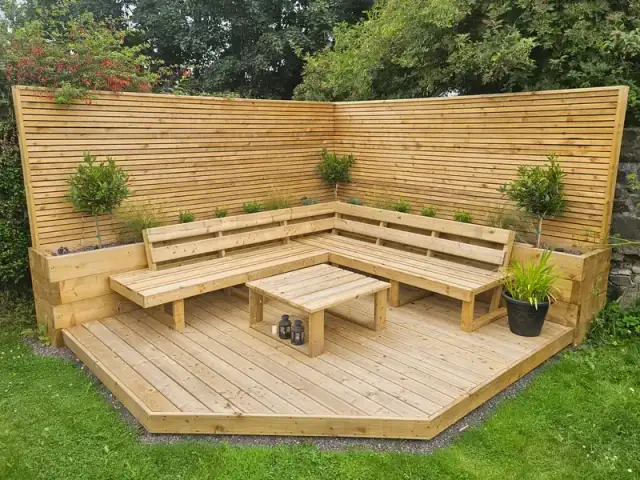
Composite decking has been the fastest-growing category in outdoor construction in Ireland for the last several years. Ask any decking installer across County Louth and they’ll tell you the same thing: more and more customers are choosing composite over treated timber, and most who’ve had it installed for five or more years are glad they did.
But composite decking costs more upfront than timber — sometimes significantly more — and not all composite products are created equal. Before spending money on it, it’s worth understanding what you’re actually paying for, where it performs better than timber, where it doesn’t, and what design options you have.
We’ve installed both timber and composite decks across Dundalk and Co. Louth for years. Here’s an honest guide.
What Composite Decking Actually Is
Composite decking boards are made by combining wood fibres (typically recycled wood material) with plastic — usually high-density polyethylene. The result is a board that looks like timber, cuts and fixes like timber, but behaves differently once it’s outside.
Better-quality composite boards are capped — meaning the wood-plastic composite core is wrapped on all four sides with a harder outer shell of pure plastic or PVC. This capping is what gives premium composite its durability advantage. Uncapped or partially capped boards allow moisture into the core over time, which eventually causes problems.
In Ireland, where decking is exposed to rain for a large portion of the year, capped composite boards from reputable manufacturers — Millboard, Trex, Cladco, Laydex’s Teranna range — perform very well. Cheap uncapped composite boards from unknown suppliers do not. The gap between the best and worst composite products is wider than most people realise.
Composite vs Timber — The Honest Comparison
Maintenance
This is where composite wins clearly in Irish conditions. A timber deck in Louth needs treating — sanding back, applying an oil or stain — every one to two years to maintain its appearance and prevent deterioration. That’s a half-day to a full day of work annually, plus the cost of materials. Skip it, and the wood fades, greys, and eventually starts to split and rot.
Composite requires an annual wash with warm soapy water or a soft brush. That’s it. The time saving over a 20-year period is substantial.
For cleaning either surface, the principles are the same — see our guide to maintaining decking for the full detail.
Durability
Quality composite boards carry manufacturer warranties of 20–25 years. Treated softwood decking typically lasts 10–15 years with proper maintenance; without it, significantly less. In Co. Louth’s wet climate, the moisture management difference matters.
The one durability caveat for composite: scratches. Composite boards scratch more easily than treated timber in high-traffic situations or if furniture legs without pads are dragged across them. Deep scratches in composite can’t be sanded out the way they can in wood. This is worth knowing before you buy.
Appearance
Early composite decking looked plastic. That era is mostly over. Good-quality composite now has convincing wood-grain texture and colour variation that looks genuinely similar to hardwood from a few metres away.
Up close, it’s not identical to real wood. If you love the look of natural grain and don’t mind the maintenance, timber is still the authentic choice. If you want something that looks good without the upkeep, modern composite is a reasonable compromise.
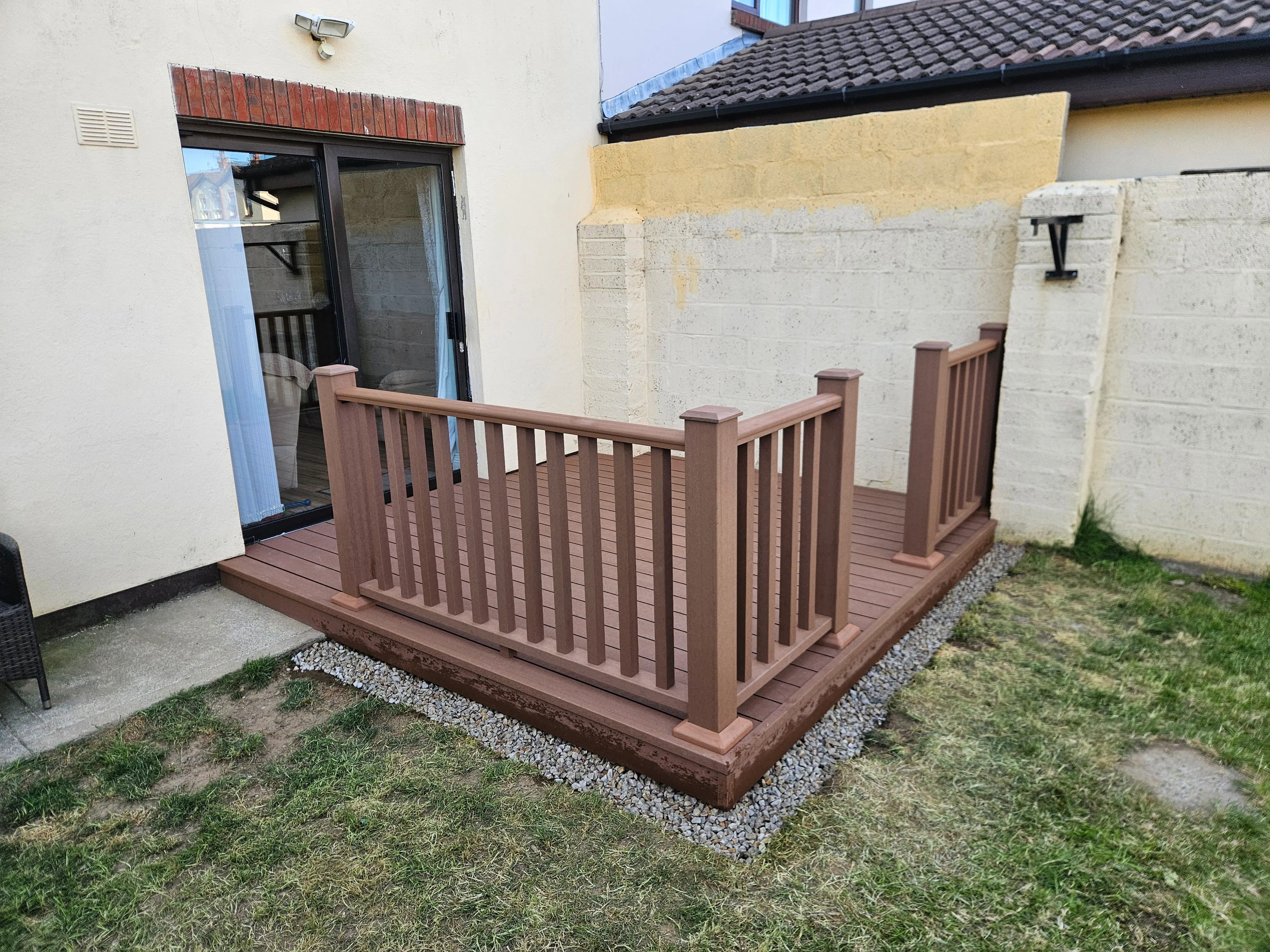
Composite boards come in a range of colours — greys, charcoals, browns, tawny tones — that allow you to match or contrast with the paving and fencing nearby. Grey composite alongside grey porcelain paving is the most common look across new builds in Dundalk right now and it works well.
Cost
Composite costs more per square metre to buy than treated softwood. The initial gap is real — budget roughly double the material cost of a softwood deck for a mid-range composite.
Over 15–20 years, the total cost including maintenance tends to even out or favour composite, because you’re not spending on annual treatment products and labour. But if upfront cost is the primary constraint, timber is the lower-cost starting point.
Approximate guide for Co. Louth:
- Treated softwood decking, professionally installed: €120–€180/m²
- Mid-range composite, professionally installed: €200–€300/m²
- Premium composite (Millboard, Trex), professionally installed: €300–€450/m²
These are supply-and-fit figures including subframe and fixings. Get written quotes for your specific project size and site conditions.
Slip Resistance
This matters in Ireland. Timber decking when wet becomes very slippery, especially as it ages and grows algae. Composite boards — particularly those with grooved surfaces — have significantly better grip when wet. For a deck used in all weathers by families with children, this is a practical safety advantage.
Design Considerations
Subframe matters as much as the boards. Composite boards are fixed to a subframe of joists, and that subframe in Irish conditions needs to be either composite, steel, or pressure-treated hardwood — not standard softwood. Softwood joists rot at connections and in ground contact within a few years, taking an otherwise durable composite deck with them. Specify the subframe when getting quotes — some quotes look attractively low because the subframe is cheapened.
Raised decking on a sloped site is one of composite’s strongest use cases. The boards sit off the ground, drain freely, and don’t suffer the constant moisture contact that causes accelerated deterioration in timber. Raised decking on sloped Co. Louth sites is one of the areas where the investment in composite pays back most clearly.
Board direction affects the look significantly. Boards running away from the house (landscape orientation) draw the eye outward and make the garden feel larger. Boards running across the deck (portrait orientation) suit narrower spaces or contemporary designs. A simple border of contrasting boards — say, a charcoal board along the edges of a grey deck — looks intentional and finished without adding complexity to the installation.
Our decking service covers both timber and composite installations across Dundalk, Blackrock, Ardee, Castlebellingham, and all of County Louth. Get in touch for a free quote and site visit.
Frequently Asked Questions
Is composite decking worth it in Ireland?
For most homeowners who want a deck that looks good without annual maintenance, yes. The Irish climate makes the maintenance case for composite stronger than it would be in a drier country — wet conditions accelerate timber deterioration and algae growth significantly. The upfront cost is higher, but the time and product costs avoided over 15–20 years are substantial.
What is the best composite decking for Ireland?
Look for fully capped boards from established manufacturers — Millboard, Trex, Cladco, and Laydex’s Teranna range are all available in Ireland and have proven track records. Avoid uncapped or partially capped boards, and avoid unknown brands with no Irish or UK installation history. Check whether the manufacturer offers a meaningful warranty (20+ years) and whether it covers fading and staining.
How long does composite decking last in Ireland?
Quality capped composite decking with a proper treated subframe should last 20–25 years. Some premium manufacturers offer warranties of 25 years or more. The subframe is often the limiting factor — if softwood joists are used in a damp, ground-level application, they may fail before the boards.
Does composite decking get slippery in Ireland?
Less so than timber, but it can still develop algae in shaded or damp positions. Composite with grooved surface texture has better inherent slip resistance than smooth timber. An annual wash in spring removes surface growth before it becomes problematic. Avoid smooth-faced composite boards in any Irish garden application — the textured or grooved versions are consistently safer.
Can composite decking be installed over an existing deck?
Sometimes, if the existing subframe is sound and level. In practice, we usually find that a deck old enough to need replacement also has subframe issues, and replacing everything is the right call for a long-lasting result. We’ll advise after seeing the existing deck during a free site visit.