
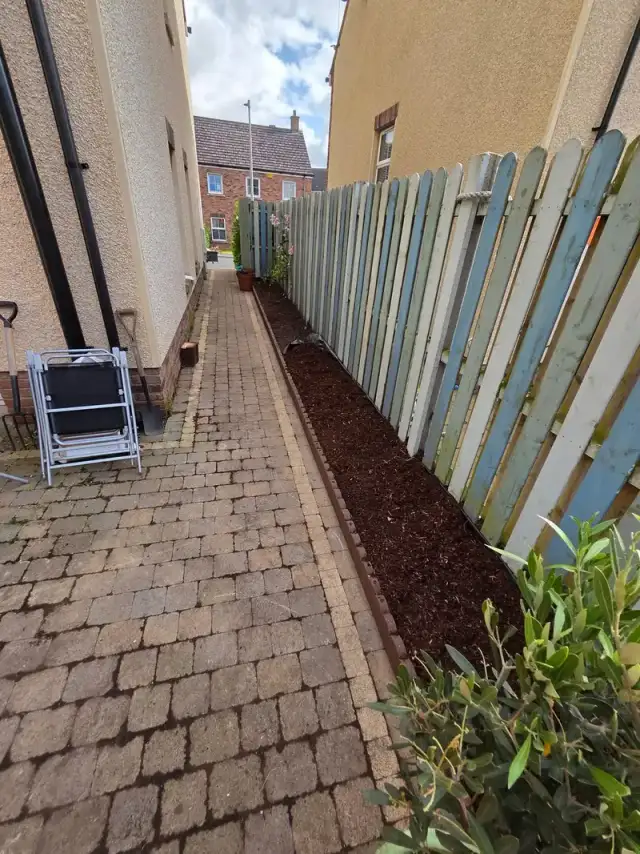
Waterlogged gardens are one of the most common complaints we encounter across County Louth. Ireland’s rainfall is generous year-round, and many parts of the county have heavy clay soils that hold water rather than allowing it to drain. The result is lawns that are unusable in winter, patios that stay wet and grow algae, and gardens that are difficult to maintain from October to March.
The good news is that most drainage problems are solvable. The approach depends on the cause and the severity, so this guide covers the main options from least to most involved.
Why Irish Gardens Waterlog
Understanding the cause helps you choose the right solution.
Heavy clay soil is the most common culprit in County Louth. Clay particles are small and pack tightly, leaving little space for water to move through. Rainfall sits on or near the surface until it evaporates or slowly seeps away.
Compaction makes the problem worse. Ground that has been trafficked by vehicles during a build, or walked on heavily when wet, becomes even less permeable. New build gardens are almost universally compacted.
High water table. In low-lying areas, the water table is naturally close to the surface and rises in wet periods. Parts of the Dundalk coastal area and some low-lying farmland in the county are prone to this.
Poor surface grading. If the garden slopes towards the house, or water pools in a low spot with no exit route, the water has nowhere to go even if the soil would otherwise drain reasonably well.
Hard surfaces with inadequate falls or no drainage outlet. Patios and paved areas that are flat, or that slope towards a wall, will hold water.
Solution 1: Improving the Soil
For mild drainage issues, improving the soil’s structure can be enough. This is most effective on new gardens before any surface is established.
Sand and grit incorporation. Working coarse sharp sand or horticultural grit into the top 200 to 300mm of clay soil opens up the structure and improves drainage. This takes significant volume of material to make a difference, typically 25 to 30% of the soil volume, and is labour-intensive on larger areas.
Organic matter. Adding well-rotted compost or green waste improves the crumb structure of clay soil over time, making it more permeable. This is a multi-year process rather than a quick fix, but it is an inexpensive improvement to make as part of routine garden maintenance.
Spiking and aeration. Hollow-tine aeration on a lawn (see lawn scarifying guide) opens channels in compacted turf that allow water to penetrate more easily. Effective for moderate compaction but not for severe drainage problems.
Solution 2: French Drains
A French drain is a trench filled with gravel, usually containing a perforated pipe, that intercepts water moving through or across the ground and carries it to an outlet. It is one of the most cost-effective drainage solutions for residential gardens.
How they work: A trench is dug, lined with permeable geotextile fabric, filled with crushed stone, and a perforated pipe is laid at the bottom. The fabric prevents the stone from silting up. Water percolates into the gravel, enters the pipe, and flows to an outlet.
Where they go: Across the garden upslope of where water pools, along boundaries, or running down the length of a long garden to a lower outlet point.
Outlets: The drain needs somewhere to discharge. Options include a soakaway (see below), a connection to a surface water drain at the boundary, or discharge to a ditch. Never connect to a foul drain.
For most County Louth gardens with moderate drainage problems, one or two French drains connected to a soakaway or boundary outlet is enough.
Solution 3: Soakaways
A soakaway is a pit filled with rubble or gravel (or a modern plastic crate system) that collects water and allows it to disperse slowly into the surrounding soil. They are used as the outlet for French drains or as standalone collection points for surface water.
Traditional rubble fill soakaway: A pit of at least 1 cubic metre, typically larger, filled with broken concrete or coarse stone. Lower cost but shorter effective life as it silts up over decades.
Plastic crate soakaway: Modern soakaway crates wrapped in geotextile fabric. More expensive but much greater capacity per cubic metre and longer effective life.
Soakaways need to be positioned at least 5 metres from any structure and away from boundaries. They only work if the surrounding soil is permeable enough to disperse the collected water. In very heavy clay or areas with a high water table, a soakaway alone will not solve the problem and water needs to be directed to an outlet rather than dispersed on site.
Solution 4: Channel Drains
A channel drain (also called a linear drain) is a surface-level slot drain, typically installed across the bottom of a slope or at the junction between a patio and a lawn. It intercepts surface water before it can pool or run where it is not wanted.
Channel drains are common on driveways to prevent water running off onto roads, and across the rear of patios where water drains from the hard surface towards the house. They require a connection to a soakaway or drainage outlet.
For gardens where surface water rather than subsurface water is the primary problem, channel drains can be very effective and relatively low cost.
Solution 5: Raising and Regrading
Sometimes the most effective solution is not a drainage system at all but a change in levels. Raising the garden surface above the waterlogged zone and grading it to drain away from problem areas can resolve issues that drainage systems only partially address.
This is particularly relevant for:
- Gardens that slope towards the house
- Low-lying areas that collect water from multiple directions
- New build gardens where the finished level is poorly set
Regrading involves importing topsoil or fill material, reshaping the ground profile, and resettling the surface before relaying lawn or planting. It is more disruptive than installing drains but can be the most durable solution.
What to Do First
If you have a waterlogged garden and you are not sure where to start:
- Observe the garden after heavy rain and note where water pools and where it drains naturally
- Dig a small test pit 500mm deep and check how quickly water drains away, or if water is already sitting at that level
- Check that any existing drainage connections at the property are clear and functioning
- Consider whether the problem is surface water (most common on patios and hard surfaces) or subsurface water (most common on lawns)
Most garden drainage problems in County Louth are solvable with a combination of French drains and a soakaway. We include a drainage assessment as part of any landscaping quote for County Louth properties.
Contact us here to arrange a free site visit and assessment. For related topics, see our garden landscaping costs guide, new build garden guide, and our garden landscaping service page.